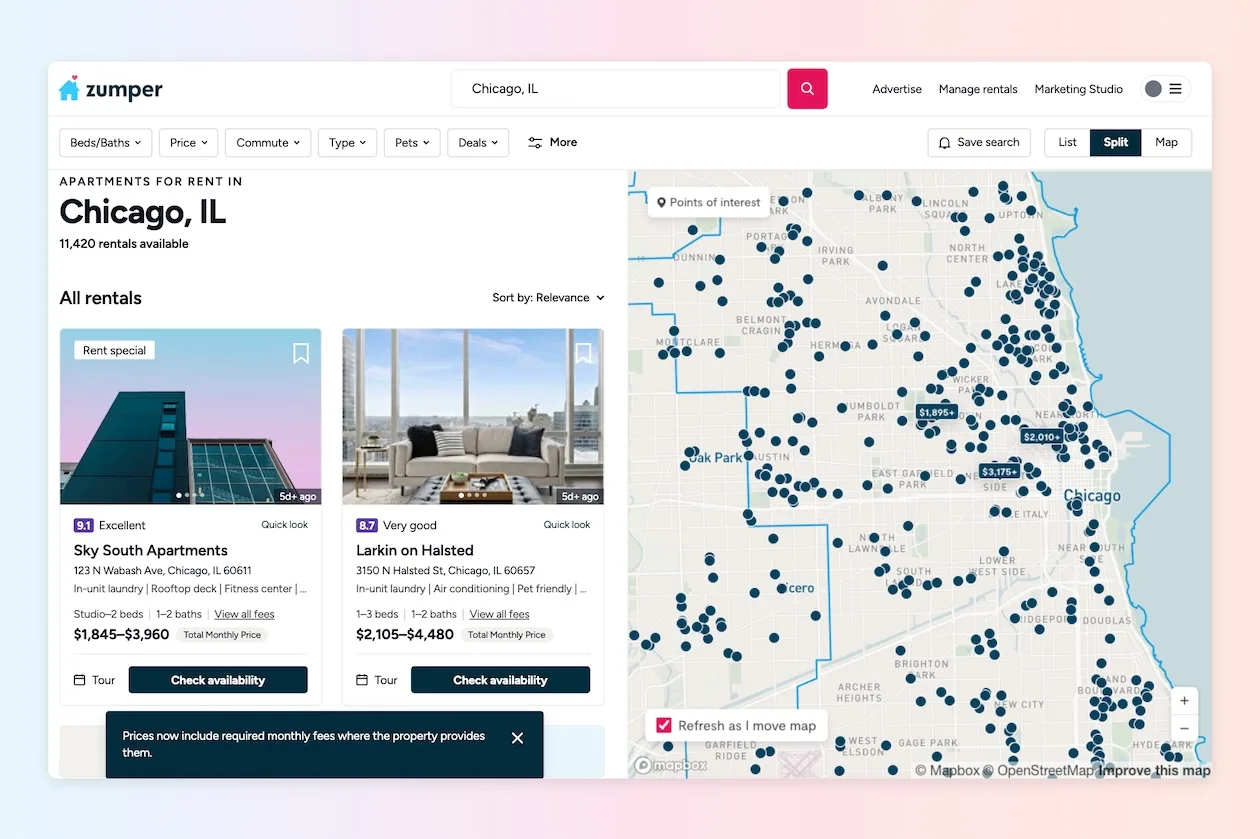
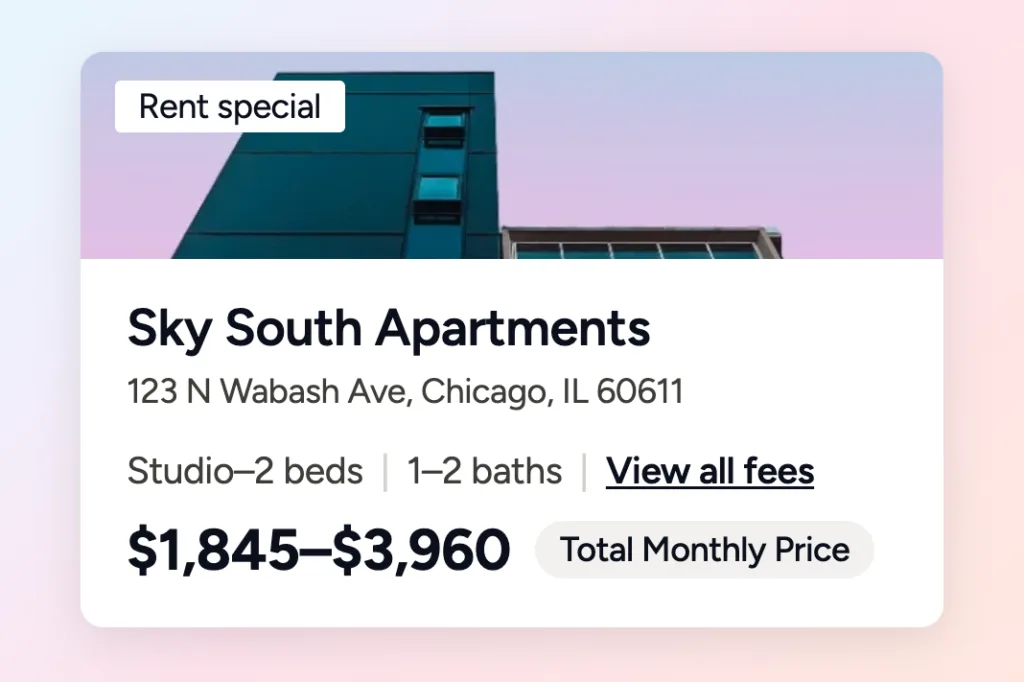
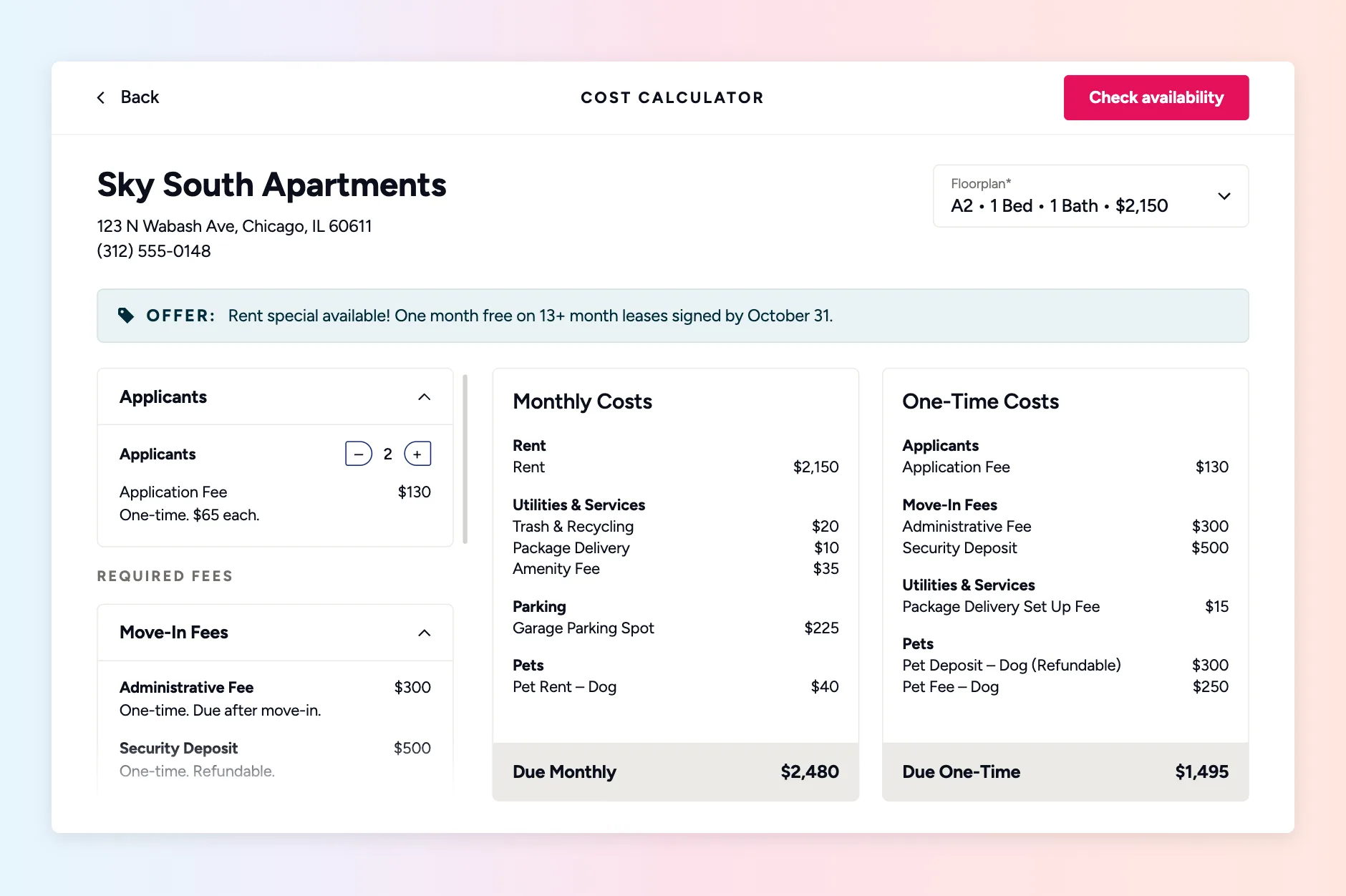
Starting in October, Zumper will show a Total Monthly Price on listings nationwide. That price combines base rent and all mandatory monthly fees, while optional and situational fees, like pets or parking, will be available in each listing’s cost calculator.
Why isn‘t rent the same as the total monthly price?
Until very recently, making purchases like buying concert tickets or booking a hotel room all ended in the same way: you picked your seats or found a room, got to the checkout, and were hit with extra fees that bumped up the price, sometimes significantly. All of that changed when the FTC handed down new regulations for those industries, requiring all fees to be included in the initial advertised price.
That same poor checkout experience has been true of renting apartments. An apartment’s base rent and its true total monthly price aren’t always the same, and across most of the country, a rental listing only has to display the base rent.
Management companies use mandatory fees to adjust to costs that change faster than rent, while also trying to stay competitive in markets where renters have historically sorted by rent price. Meanwhile, renters are trying to compare apartments and set budgets, neither of which is possible if the total is not, in fact, the total.
What’s changing on Zumper?
Starting in October, Zumper will display a Total Monthly Price—base rent plus mandatory monthly fees—on listings nationwide wherever properties have given us the fee data to calculate it. Alongside this change, renters can use the existing cost calculator on every Zumper listing to add optional fees that apply to them—like pets and parking spaces—to get to a total that reflects their specific needs.
How did we get here?
When Massachusetts, Nevada, Connecticut, and Virginia passed their fee disclosure laws last year, Zumper, along with other tech companies in the multifamily industry, worked with RETTC’s MITS 5 working group to build toward a shared industry standard for capturing total monthly price. The changes touched many surface areas, including how data passed between systems. The structure supporting all the variations of fee attributes became one of the more complicated blueprints in our database.
The response after launch convinced us we were on the right track. Operators told us their prospects arrived better informed. Renters told us the same thing from the other side: there’s no such thing as too much information up front. In fact, in our Annual Renter Survey, 95% of renters said seeing all-in pricing from the start of their search was somewhat or very important. The big takeaway is that the more transparency between a community and a prospective resident, the smoother the leasing journey is for both parties.
Why not roll this out state by state?
One option was to update the Zumper marketplace state by state as new laws passed. But a few things argued against slow-playing.
The first was practical: a platform with two kinds of pricing leaves renters unsure which listings show the total monthly price. The second is that all-in pricing is hardest on whoever moves first. An operator who discloses everything looks more expensive next to a neighbor who hasn’t, which is an unfair penalty for being transparent. Making it the standard across our solutions is the only version where that penalty is removed.
The law will most likely get there on its own—the FTC opened a rulemaking on rental fees in March, and more than two dozen state attorneys general wrote in to support it—but we didn’t see a reason to wait for the requirement when we already had the infrastructure built.
What this looks like on a listing depends on how much we have to work with; until we have perfect data, our listings won’t be perfect. Our goal, therefore, became to create distinct use cases that are easy to understand, sharing openly what we know, and what we don’t know.
What exactly will renters see?
A listing will have one of four experiences, depending on how complete the fee data is. Here’s the language for each case, along with what it means.
| What renters see | When it appears | What the listing says |
| Total Monthly Price | We have all required monthly fees and the lease term. | The price shown reflects a 12-month lease and includes base rent and all known required monthly fees, based on information provided by the property. |
| Total Monthly Price | We have all required monthly fees, but no lease term. | The price shown includes base rent and all known required monthly fees, based on information provided by the property. |
| Additional Fees May Apply | The property lists fees, but the information is incomplete. | The price shown reflects base rent. Based on information provided by the property, additional fees may apply, but no required monthly charges have been confirmed. |
| Fees May Apply | No fee information has been provided. | The price shown reflects base rent. Fee information is not available from the property, so additional fees may increase the total monthly cost. |
The main outcome here is that fee awareness is granted at first contact with the listing—it is not buried behind drawers or multiple clicks.
How do I get Total Monthly Price on my listings?
Everything depends on Zumper having your fee data. There are three ways to make this happen.
If you use a system we’re already integrated with, your fees can flow to us automatically. That list currently includes Yardi, RealPage, Entrata, AppFolio, ResMan, Funnel, and Engrain, among others. Check with your rep that fee data is enabled in your feed—using one of these systems isn’t the same as having the fee fields populated.
If you use a system that supports fee transparency but isn’t on that list, contact our Client Services team. We’ve built toward the MITS 5 standard, so adding a new source can be as simple as connecting each company’s technical teams.
If neither applies and you are a Zumper client, send us the fees directly, and we’ll enter them on your behalf.
What’s next?
While fees are one aspect of renting that has lacked visibility, other areas still need improvement. One example is unit-level detail. The floor, the exposure, what amenities actually come with that specific apartment rather than the building around it—a lot of that detail is still trapped in systems upstream. That’s what Zumper is working on next for renters. The principle is the same one that got us here: the clearer the picture at first glance, the better the leasing experience for renters and property management companies alike.
Where can I learn more?
Fee disclosure requirements vary by state, and they’re still changing. You can review the primary sources for the jurisdictions that have acted so far below.
State laws and regulations
- Massachusetts — 940 CMR 38.00, effective September 2, 2025
- Connecticut — SB 3, effective October 1, 2025
- Nevada — AB 121, effective October 1, 2025
- Colorado — HB25-1090, effective January 1, 2026
- Virginia — § 59.1-608, effective July 1, 2026
- Minnesota — MN Stat. § 504B.120, effective January 1, 2025
- New Mexico — SB 267, effective June 20, 2025
- Oregon — HB 3521, effective January 1, 2026
- New York City — FARE Act, effective June 11, 2025
Federal
Standards and industry
- RETTC MITS data models, including the MITS 5 property marketing standard
- Zumper’s guide to fee transparency, which has a state-by-state table
Related content