Zumper’s rent calculator tells you how much rent you can afford based on your income, expenses, and financial goals, and then connects that number directly to real listings in your city. It uses the 30% rule as its baseline: calculating 30% of your gross monthly income, and then adjusting for your actual financial situation including debt payments, savings goals, and local cost of living. This approach transforms an overwhelming apartment search into a focused hunt for units that fit your real-world budget.
But there are multiple ways of determining your rental budget. Whether you’re a recent graduate navigating your first paycheck, a professional relocating to a new city, or a current renter considering an apartment upgrade, understanding how to use a rent calculator effectively is the first step toward finding housing that supports your financial health rather than straining it.
What is a rent calculator and how does it work?
A rent calculator is an online tool that estimates how much rent you can comfortably afford based on your income and unique financial circumstances, usually using established affordability guidelines (like the 30% rule). You input your financial details, like your annual or monthly income, existing debt payments, and sometimes your savings goals, and the calculator then returns a recommended rent range that aligns with those affordability guidelines.
Most rent calculators use the 30% rule as their foundation, which suggests that housing costs should not exceed 30% of your pre-tax monthly income. However, many calculators allow you to factor in additional variables like debts (student loan payments, car payments, credit card debt, etc.) or your desired savings rate to produce a more personalized recommendation that accounts for your financial big-picture.
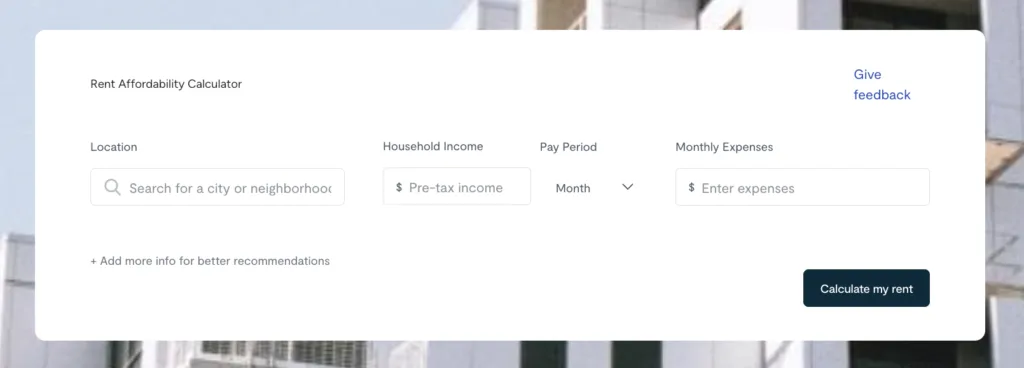
The output you get from any of these calculators is a straightforward dollar amount representing the maximum monthly rent you should consider. Some calculators show you a comfortable range, distinguishing between what you can afford at the upper limit and what you should target for greater financial flexibility. Zumper’s rent calculator takes this a step further by connecting your affordability number directly to available listings in your area, so you can immediately see real apartments within your budget.
Understanding the inputs matters as much as the output. When a calculator asks for your income, it typically means gross income, or how much you make before taxes and deductions. This distinction is important because using net income, or post-tax income, would produce a lower affordability threshold. While this may be more conservative and allow for more discretionary income, it doesn’t align with how landlords and property managers evaluate applications, and could limit the number apartments served to you as options in your area (depending on your income and market rates in your area).
The 30% rule: a starting point, not a strict limit
The 30% rule states that you should spend no more than 30% of your gross monthly income on rent. This guideline originated from 1960s federal housing policy and remains the most widely cited benchmark for rent affordability, but it was never intended to be a one-size-fits-all prescription.
For someone earning $50,000 annually, the 30% rule suggests a maximum rent of $1,250 per month. At $75,000, that ceiling rises to $1,875. What this doesn’t account for is the wide variation in individual financial circumstances, or, the rising cost of rents in cities across the United States, where most people are experiencing slower income increases as compared to rent costs.
A major takeaway to keep in mind when using a rent calculator or calculating rent affordability, is that the 30% rule provides a useful anchor, but your personal affordability number should reflect your actual budget, not just a generic formula—especially since rent is often not the only housing cost.
How to calculate how much rent you can afford based on gross monthly income
To calculate how much rent you can afford, divide your annual gross income by 12 to get your gross monthly income, then multiply that figure by 0.30. This gives you a baseline affordability estimate, a starting point that most landlords and property managers will recognize as financially sound.
Here’s the formula in action:
- Annual gross income: $60,000
- Gross monthly income: $60,000 ÷ 12 = $5,000
- Maximum rent at 30%: $5,000 × 0.30 = $1,500
If you know your hourly wage but not your annual salary, you can use a separate calculator, like ADP’s salary to hourly calculator, in reverse: multiply your hourly rate by the number of hours you work per week, then multiply by 52 weeks to get your annual income. For example, $25 per hour at 40 hours per week equals $52,000 annually, which translates to roughly $1,300 per month in affordable rent.
For renters who may qualify for income-based housing programs, the calculation works differently. These programs use adjusted gross income and apply different percentage thresholds. Learn more about how income-based apartments calculate rent if you think you might be eligible.
Apartment fee calculators: Additional housing costs beyond rent
Oftentimes, total housing cost includes more than the rent listed on a lease.
Many apartments also charge recurring fees that aren’t included in the advertised rent:
- Pet rent or pet fees for animal owners
- Parking fees, especially in urban areas
- Amenity fees for access to gyms, pools, or common areas
- Trash valet or package locker fees
- Administrative fees charged monthly or annually
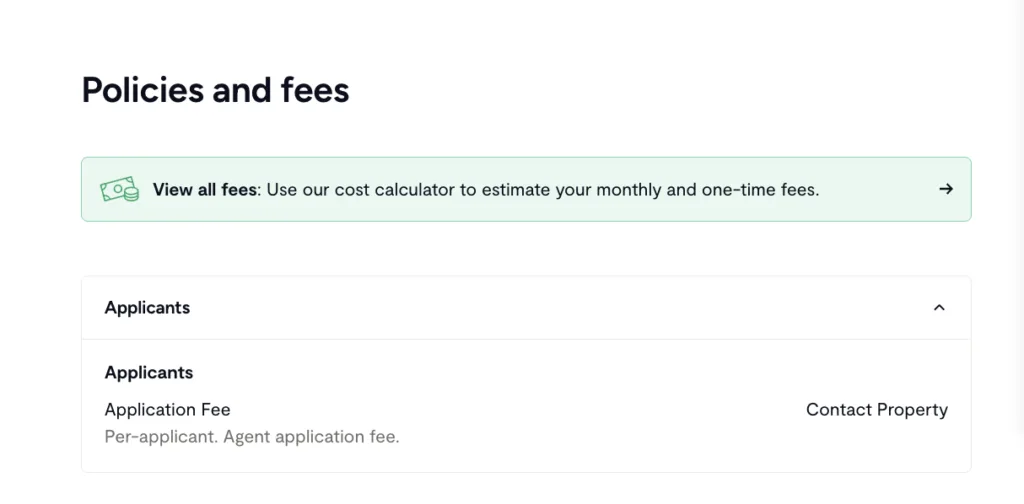
To help you determine the actual cost of these fees, Zumper has a fee cost calculator on its listing pages so you can understand what you would owe monthly, and what you would need to pay as a one-time fee, for each available apartment. With these numbers, you can cross-reference the actual apartment cost against your monthly rental budget.
Other housing costs to consider
In addition to your monthly rent and fee payments, you may also want to consider other hidden rental costs, like utilities and insurance, to your monthly housing financial estimates.
Utilities represent the most significant variable cost. Depending on your lease terms and local rates, you may be responsible for electricity, gas, water, sewer, trash collection, and internet. Renter’s insurance is another cost that’s easy to overlook but increasingly required by landlords. Our renter’s insurance guide explains what coverage you need and how to find affordable options.
Failing to account for these expenses is one of the most common budgeting mistakes first-time renters make, and it can turn an “affordable” apartment into a financial strain. Estimate the cost and add the number the Zumper rent calculator’s “expense” field.
How cost of living affects rent affordability in different cities
The housing options available to your income level can vary significantly depending on your city, which is why its critical to consider cost of living, especially for anyone relocating. Rent affordability is always relative to local market conditions, not just your paycheck.
The rental market looks very different across the US. In some cities, like St. Louis, where the median one-bedroom rent is $950 a month and 37% below the national average (according to Zumper’s Monthly Rent Report) a $50,000 salary stretches further. By comparison, that same salary may not cover even a studio apartment at the 30% threshold in New York City, where studios are an average of $3,850 per month, forcing renters to either spend a higher percentage of income on housing or seek roommates and alternative arrangements.
Local cost of living extends beyond rent. When evaluating a new market, look at real data rather than assumptions. Zumper’s Las Vegas rent research, for example, shows current median rents by bedroom count, neighborhood-level pricing, and the city’s overall average cost of living, as well as the cost of common expenses. This is the kind of granular information that can help you decide your real rental budget.
Find apartments in your budget with Zumper
Once you know your affordability number, the next step is finding actual apartments that fit within it—and that’s where Zumper’s real-time listing data becomes your advantage. Unlike generic calculators that stop at a dollar figure, Zumper connects your budget directly to available units in your target market.
Start by using the rent calculator to establish your comfortable rent range. Then filter Zumper’s listings by price, location, bedroom count, and amenities to see exactly what’s available within your budget.
The platform also surfaces neighborhood-level data that helps you make informed tradeoffs. For example, if you live in Miami with a salary of $100,000 a year, maybe Wynwood is your ideal neighborhood, but exceeds your budget. An adjacent area with similar transit access and amenities comes in hundreds of dollars cheaper, and you can get that information from Zumper’s commute time filter, and POI overlay on the map.
The difference between a frustrating apartment search and a successful one often comes down to preparation. Calculate your affordability, account for hidden costs, adjust for your personal financial goals, and then search with confidence. Your next apartment is out there—and now you know exactly what you can afford to pay for it.
Frequently asked questions about using a rent calculator
What is a rent calculator and how does it work?
A rent calculator is an online tool that estimates how much rent you can afford based on your income and financial situation. You enter your gross annual or monthly income, and the calculator applies affordability guidelines—typically the 30% rule—to produce a recommended maximum rent. More advanced calculators also factor in debt payments and savings goals to give you a personalized affordability range rather than a single number.
How much rent can I afford based on my income?
You can afford approximately 30% of your gross monthly income in rent as a general guideline. To calculate this, divide your annual salary by 12, then multiply by 0.30. For example, a $60,000 annual salary equals $5,000 per month gross, which means a maximum rent of $1,500. However, this baseline should be adjusted downward if you have significant debt or savings goals competing for the same income.
What is the 30% rule for rent, and is it still realistic?
The 30% rule suggests spending no more than 30% of your gross monthly income on rent. It remains a useful starting point for budgeting, but it’s not always realistic in high-cost housing markets where median rents exceed what 30% of median incomes can cover. The rule works best as a guideline rather than a strict limit—your actual affordable rent depends on your complete financial picture, including debt, savings goals, and local cost of living.
Should I use gross or net income when calculating rent affordability?
Use gross income when calculating rent affordability. Gross income is your earnings before taxes and deductions, and it’s the standard measure landlords use when evaluating rental applications. Most landlords require that your gross income equal at least three times the monthly rent. Using net income would produce a more conservative estimate, which isn’t wrong, but it doesn’t align with how the rental industry assesses affordability.
What factors should I consider beyond a rent affordability calculator?
Beyond the calculator output, consider utilities, renter’s insurance, parking fees, pet fees, and other recurring costs that increase your true monthly housing expense. Also factor in your debt payments, savings goals, and the cost of living in your target city. A budget calculator that accounts for all spending categories—not just rent—gives you a more accurate picture of what you can sustainably afford each month.
How do I calculate my rent-to-income ratio?
To calculate your rent-to-income ratio, divide your monthly rent by your gross monthly income, then multiply by 100 to express it as a percentage. For example, if you pay $1,200 in rent and earn $4,800 per month gross, your ratio is 25% ($1,200 ÷ $4,800 = 0.25). Landlords typically look for ratios at or below 30–33%, and a lower ratio indicates greater financial flexibility.
Related content