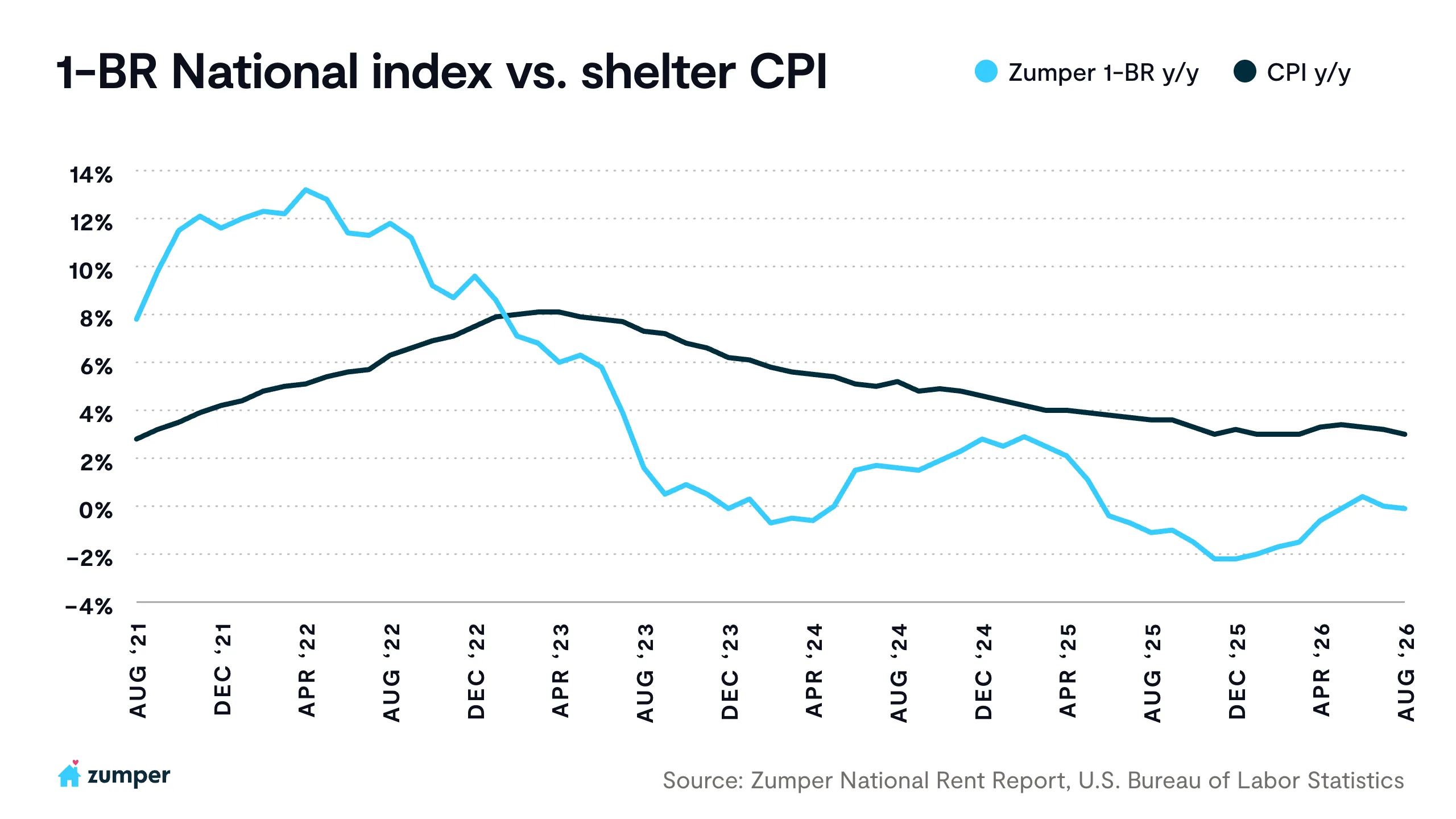
Zumper’s rent data provides insights to where the Consumer Price Index (CPI) is heading
Produced monthly by the Bureau of Labor Statistics (BLS), the Consumer Price Index (CPI) is a measure of the average change over time in the prices paid by urban consumers for goods and services, including rent. Since the Cost of Shelter CPI uses existing paid rents, among other data points, as part of its calculation, there is a lagging nature to the CPI’s shelter cost component. Zumper’s data, however, serves as a leading indicator of shelter cost as we measure true market rents.
The August CPI report showed headline inflation picking back up, rising 0.4% for the month on a seasonally adjusted basis, up from July’s 0.1% increase, while the trailing 12-month rate held at 3.4%.The shelter index rose 0.3% in August, up from July’s 0.1% pace, even as its year-over-year rate continued to ease, slipping to 3% from 3.2% in July.
This is where Zumper’s forward-looking data adds important texture. One-bedroom rent slipped to -0.1% year-over-year in August, giving back July’s flat reading, while two-bedroom rent held its gain at 0.5%, its strongest reading in over a year. The market is still telling two different stories depending on bedroom type, but neither one currently points toward the kind of acceleration August’s shelter CPI reading might suggest on its own. Leases signed during the soft rental environment of late 2024 and early 2025 are still cycling through the BLS’s rotating survey panel, and that mechanical drag should keep pulling on shelter CPI for months yet, even in a month like August where the market itself was mixed at best.
For the Fed, August’s report ended the debate as policymakers raised the federal funds rate by a quarter point on September 16, to a target range of 3.75%-4.00%, the first hike since 2023, with officials pointing to one more possible increase before year-end. Shelter, still the single largest contributor to core CPI, remains the structural swing factor to watch, and its continued deceleration is one of the few parts of the August report that argued against tightening rather than for it. That sets up a genuine open question heading into the fall: higher mortgage rates are often assumed to push more renters to stay put and lift rents, but the relationship has historically been murkier than that framing suggests, and elevated supply has done far more to shape rents these past few years than rate policy has. With one-bedroom rent still negative and two-bedroom rent’s gains still modest, the market itself, not the rate decision, remains the more reliable signal to watch.
Related content