TL;DR: The cost of living in San Francisco is 77.9% higher than the national average, and once everything stacks up, your monthly expenses could run you $8,000 per month, according to Zumper’s data and C2ER’s Cost of Living Index. A one-bedroom apartment costs a median of $3,670/month and a two-bedroom runs $5,010/month. To comfortably afford a one-bedroom using the 30% rule, you need to earn at least $148,000 per year. The biggest expenses for most residents are housing (+138.9% above the U.S. average per C2ER), utilities (+46.4%), and transportation (+42.5%).

San Francisco is one of the most iconic and expensive cities in the United States. With a population of approximately 827,500 residents, the city sits at the intersection of world-class culture, a dominant global tech economy, and famously high housing costs. Whether you’re relocating for a job, considering a move from another California city, or simply trying to understand the numbers, this guide breaks down the complete cost of living in San Francisco in 2026, with data on every major spending category, city comparisons, and practical strategies for making it work.
How much does it cost to live in San Francisco?
The total estimated monthly cost of living in San Francisco is $8,479, approximately 77.9% higher than the national average. That figure covers housing, groceries, transportation, utilities, healthcare, and miscellaneous personal expenses for a typical single-person household according to C2ER’s Cost of Living Index averages. Every major spending category in San Francisco runs above the U.S. baseline.
| Category | SF monthly cost | vs. national avg. |
| Housing | $5,216 | +138.9% |
| Miscellaneous | $1,215 | +21.0% |
| Groceries | $802 | +15.4% |
| Utilities | $543 | +46.4% |
| Transportation | $523 | +42.5% |
| Healthcare | $180 | +23.3% |
| Total | $8,479 | +77.9% |
Housing is by far the largest driver, coming in nearly 139% above the national average. This housing number accounts for renting and ownership expenses, per C2ER. Rent alone in San Francisco is 144% above national average for a monthly 1-bedroom. Utilities and transportation follow, each running more than 40% above baseline. Even groceries, the category with the smallest premium, cost about 15% more than the US average.
How much is rent in San Francisco?
As of mid-January 2026, median rent for a one-bedroom apartment in San Francisco is $3,670 per month. A two-bedroom apartment runs a median of $5,010 per month. Both figures are significantly above the national medians of $1,503 (one-bedroom) and $1,879 (two-bedroom).
A few key comparisons that put San Francisco rent in context:
- A San Francisco one-bedroom costs $2,167 more per month than the national median. That’s 144% more than the national average, or over $26,000 extra per year on rent alone.
- Compared to other California cities, SF one-bedrooms are $1,380/month more expensive than Los Angeles and $2,170/month more than Sacramento.
- Even within the Bay Area, Oakland’s median one-bedroom at $1,980 runs meaningfully below San Francisco’s.
San Francisco’s rental market is shaped by its geography, the city is a peninsula with hard boundaries on developable land, combined with historically slow new housing production. The result is persistent high demand and limited supply, especially for apartments in popular neighborhoods like the Mission, Hayes Valley, Noe Valley, and the Castro.
How much do you need to earn to afford San Francisco?
To afford a one-bedroom apartment in San Francisco without spending more than 30% of gross income on rent, you need to earn at least $12,353 per month, or roughly $148,000 per year. The city’s median household income is $141,446, which means a single median-income earner renting solo is right at, or slightly above, the commonly cited affordability threshold.
Here’s how income requirements shift based on housing arrangement:
- Solo in a 1-bedroom: ~$148,000/year needed
- Solo in a 2-bedroom: ~$200,400/year needed
- Splitting a 2-bedroom with one roommate: ~$100,200/year each
- Splitting a 2-bedroom three ways (if applicable): ~$66,800/year each
A key point to remember here is that this affordability calculation is just based on rent expenses alone, but whether or not San Francisco is affordable for you depends on your personal financial situation (student loans, debts, childcare or other dependencies), and the necessary income could be different.
It’s also important to factor in California’s state income tax. The state uses a progressive tax structure with nine brackets, ranging from 1% to 12.3% (plus a 1% mental health surcharge on income over $1 million). A household earning around $148,000 can expect an effective California state tax rate of roughly 7–9% on top of federal obligations — a meaningful addition to the overall cost of living equation.
How much do groceries cost in San Francisco?
Groceries in San Francisco cost approximately $802 per month for a typical household — about 15.4% above the national average. Again, we want to note that this is an average provided by the Center for Economic Research, and could be a highly personalized number depending on your dietary habits and needs. However, the table below shows prices for common items to help paint a more robust picture of daily food costs:
| Item | SF price | National index |
| Dozen eggs | $2.99 | 100 |
| Gallon whole milk | $5.20 | 100 |
| Loaf of bread | $4.41 | 100 |
| Ground beef (lb) | $8.05 | 100 |
| Steak (lb) | $17.23 | 100 |
| Coffee (ground, 11.5 oz) | $7.33 | 100 |
| Bananas (lb) | $0.87 | 100 |
A few grocery budget strategies that could work well in San Francisco:
- Heart of the City Farmers’ Market at UN Plaza (Wednesday and Sunday) offers fresh, locally-grown produce at competitive prices — one of the best tools for trimming the grocery bill.
- Asian supermarkets in the Sunset and Richmond Districts (such as Ranch 99 and Sun Fat Seafood) can sometimes offer lower prices on produce, seafood, and pantry staples.
- Grocery Outlet and Trader Joe’s locations around the city provide meaningful savings compared to premium chains like Whole Foods or Bi-Rite.
- Meal planning and cooking at home makes an especially large difference in SF, where dining out adds up quickly.
How much does transportation cost in San Francisco?
Monthly transportation costs in San Francisco average $523, which is about 42.5% above the national average. However, how you choose to get around has a major impact on this number.
What does public transit cost in San Francisco?
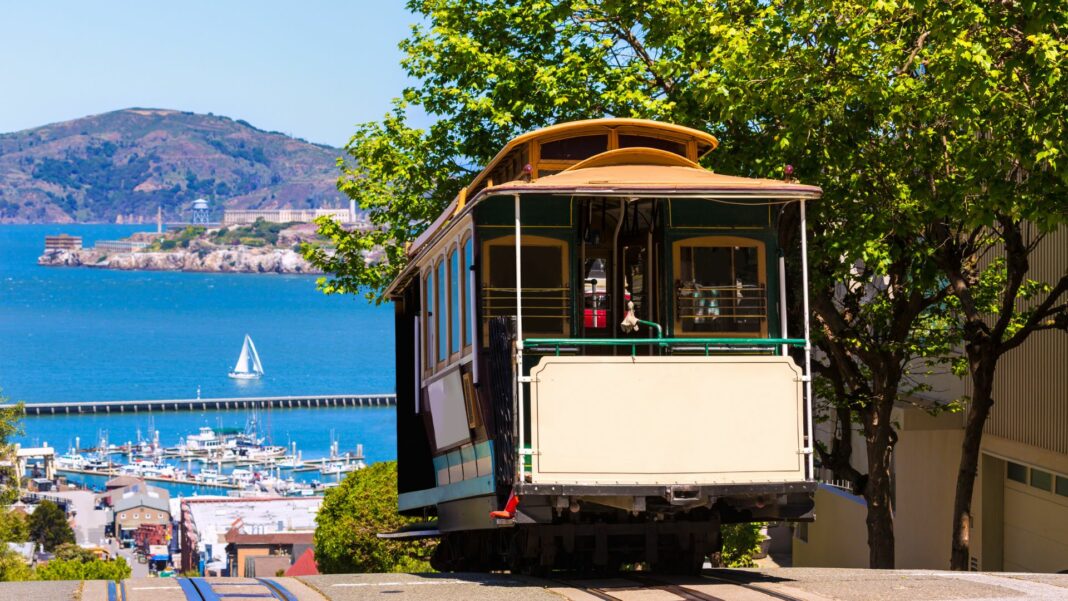
San Francisco has one of the best public transit systems among U.S. cities. The San Francisco Municipal Railway (Muni) runs buses, light rail, cable cars, and historic streetcars throughout the city. Current adult monthly pass prices:
- Muni-only monthly pass: $86/month
- Muni + BART within SF combined pass: $104/month
- Single ride (Clipper or tap-to-pay): $2.85
BART connects the city to the East Bay, Oakland, Berkeley, and the broader region. Fares are distance-based. Many SF residents who commute to South Bay employers (Caltrain) or East Bay jobs (BART) find transit to be cost-effective and practical.
What does car ownership cost in San Francisco?
Owning a car in San Francisco is genuinely expensive and logistically challenging. Key costs to budget for:
- Gas: $4.58 per gallon (about 41% above the national average)
- Car insurance: significantly above the national average due to urban density and theft rates (this is not to say that SF has a high crime rate; car break-ins are at a 22-year low, and the city overall is seeing a decrease in crime overall).
- Parking: residential garage spaces often run $200–$400/month; street parking is metered or requires a permit in much of the city, and competitive everywhere
- Maintenance: tire balancing runs $78.78 locally
For these reasons, many San Franciscans choose to go car-free, relying instead on Muni, BART, and cycling, which can significantly reduce transportation costs below the category average.
What do utilities cost in San Francisco?
Monthly utility costs in San Francisco average $543, or 46.4% above the national average. This is one of the larger category premiums in the budget, driven primarily by California’s high electricity rates rather than excessive energy consumption. PGE is the sole energy provider for gas and electricity in San Francisco, and while the city’s mild, foggy climate means residents rarely run need heavy heating or air conditioning, much of the city’s housing stock is comprised of older builds, often translating to older, less efficient climate control. So, when they are used, rates tend to run higher than they are elsewhere in the country.

Additional household cost benchmarks in San Francisco:
- Cell phone plan: ~$206.74/month (per local index data)
- Internet service: comparable to other major metros, typically $60–$100/month depending on provider and speed
How much does healthcare cost in San Francisco?
Healthcare costs in San Francisco average $180 per month for a typical household. This is about 23% above the national average. Here’s a breakdown of common out-of-pocket costs:
- Doctor visit: $184.23
- Dentist visit: $167.93
- Optometrist visit: $173.17
- Prescription drugs: $25.58
The quality of healthcare in San Francisco is excellent, particularly for those who are insured. UCSF Health is consistently ranked among the top hospital systems in the country, and Stanford Health is present in the greater Bay area, so the city attracts talented and knowledgeable specialists, clinics, and community health centers. Kaiser maintains a strong presence in the city, as well, and because of the tech sector, concierge medical services also scatter the city. Most major employers, particularly tech, offer comprehensive health benefits that can help offset medical costs.
How does San Francisco compare to other cities?
San Francisco is expensive even by major-city standards, but it isn’t the priciest metro in the country. Here’s a direct comparison against three other major US cities and the national average:
| City | 1-BR rent | 2-BR rent | Total monthly |
| San Francisco, CA | $3,670 | $5,010 | $8,479 |
| New York City, NY | $4,320 | $5,140 | $10,941 |
| Seattle, WA | $1,920 | $2,800 | $7,121 |
| Los Angeles, CA | $2,290 | $3,110 | $7,138 |
| National average | $1,503 | $1,879 | — |
Key takeaways from the comparison:
- New York City’s total monthly expenses of $10,941 exceed San Francisco’s $8,479, primarily due to extreme Manhattan rents. NYC’s overall one-bedroom median of $4,320 is also higher.
- Seattle and Los Angeles both have meaningful tech economies and are significantly less expensive overall, with total monthly costs of $7,121 and $7,138 respectively.
- San Francisco’s one-bedroom rent of $3,670 is $1,380 more per month than Los Angeles ($2,290) and $1,750 more than Seattle ($1,920).
- Compared to a lower-cost city like Houston (total monthly: $4,366, 1BR: $1,210), San Francisco costs nearly twice as much to live in each month.
At the state level, California’s average monthly cost across all cities tracked is $6,788. San Francisco’s $8,479 runs $1,691/month above the state average, confirming that SF carries a premium even within an already high-cost state.
What are the major employers and industries in San Francisco?
San Francisco’s tech economy is the primary driver behind both its high salaries and its high cost of living. The city is home to some of the world’s most valuable companies and is the global center for AI investment, with the Bay Area attracting three-quarters of all U.S. AI venture capital funding since 2019.
Major employers across industries include:
- Technology: Salesforce (12,000+ SF employees — the city’s largest private employer), Uber, Airbnb, Stripe, Block (Square), Cloudflare, OpenAI, Anthropic, Figma, Reddit, and an intense number of small startups
- Financial services: Wells Fargo, Charles Schwab, and other major international banking institutions
- Healthcare and life sciences: UCSF, Dignity Health, Sutter Health; the broader Bay Area life sciences sector supports 302,000 direct and indirect jobs
- Hospitality and tourism: Moscone Center, hotel groups, and a thriving restaurant industry
The Bay Area holds the top spot in CBRE’s annual Scoring Tech Talent report for the 12th consecutive year, and the average annual wage for tech talent employed by tech companies in San Francisco was $215,072 (as of 2023), the highest of any U.S. metro. Entry-level software engineering roles at major SF employers typically start between $95,000 and $180,000.
What are the best tips for saving money in San Francisco?
Living affordably in San Francisco is possible with the right habits and tradeoffs. The most impactful strategies:
- Get a roommate: Sharing a two-bedroom can help cut your housing cost nearly in half. This could be the single most effective cost-reduction move available to SF renters.
- Go car-free: Skipping car ownership and using Muni, BART, and rideshares saves hundreds per month compared to the average driver in the city.
- Shop strategically: Grocery Outlet, Trader Joe’s, and the Heart of the City Farmers’ Market offer meaningful savings over premium chains.
- Explore affordable neighborhoods: The Outer Sunset, Excelsior, Ingleside, and Visitacion Valley offer lower rents while still providing solid Muni access to the rest of the city.
- Leverage free entertainment: The city’s 230 parks, including Golden Gate Park, free museum nights at SFMOMA, and the city’s many free neighborhood festivals or outdoor activities make a rich social life accessible without a big entertainment budget.
- Negotiate remote or hybrid work: Working remotely even a few days per week while earning a Bay Area salary is one of the most powerful ways to improve your financial position in SF.
Frequently asked questions
What is the cost of living in San Francisco?
The total estimated cost of living in San Francisco is $8,479 per month, which is 77.9% higher than the national average. This includes housing ($5,216), miscellaneous expenses ($1,215), groceries ($802), utilities ($543), transportation ($523), and healthcare ($180).
How much is rent in San Francisco in 2026?
The median rent for a one-bedroom apartment in San Francisco is $3,670 per month. A two-bedroom apartment has a median rent of $5,010 per month. Both are more than double the national medians of $1,503 (one-bedroom) and $1,879 (two-bedroom).
How much do you need to earn to live in San Francisco?
To afford a one-bedroom apartment without spending more than 30% of gross income on rent, you need to earn at least $148,000 per year ($12,353/month). Sharing a two-bedroom with a roommate lowers this to approximately $100,200 per year per person.
Is $100,000 a good salary in San Francisco?
A $100,000 salary in San Francisco is considered below the comfortable living threshold for solo renters. Given the median one-bedroom rent of $3,670/month, a $100,000 salary (roughly $8,333/month gross) would put housing at about 44% of income — well above the recommended 30% threshold. That said, $100,000 is manageable with a roommate or by living in a more affordable neighborhood.
What is the cheapest neighborhood to rent in San Francisco?
The most affordable neighborhoods in San Francisco for renters tend to be the Outer Sunset, Excelsior, Ingleside, Visitacion Valley, and parts of Bayview-Hunters Point. These areas offer lower rents than the city’s most in-demand neighborhoods while still providing Muni access to the rest of the city.
How does San Francisco compare to New York City for cost of living?
New York City is actually more expensive overall than San Francisco, with total monthly expenses of $10,941 compared to San Francisco’s $8,479. NYC’s median one-bedroom rent of $4,320 is also higher than San Francisco’s $3,670. However, San Francisco’s housing index runs higher on a national percentage basis, and its utility costs are a steeper premium above average.
Is San Francisco more expensive than Los Angeles?
Yes. San Francisco is more expensive than Los Angeles across most categories. San Francisco’s median one-bedroom rent is $3,670 vs. $2,290 in Los Angeles, and total monthly expenses in SF ($8,479) exceed LA’s ($7,138) by more than $1,300 per month.
Does California have a state income tax?
Yes. California has a progressive state income tax with nine brackets ranging from 1% to 12.3%, plus a 1% mental health services surcharge on income over $1 million. It is among the highest state income tax rates in the country and an important factor in calculating take-home pay for San Francisco residents.
What is public transit like in San Francisco?
San Francisco has one of the strongest public transit networks among U.S. cities. Muni operates buses, light rail, cable cars, and historic streetcars throughout the city, with an adult monthly unlimited pass at $86 (or $104 including BART within city limits). BART provides regional rail access to Oakland, Berkeley, and the South Bay. Many residents choose to go entirely car-free.
What industries are hiring in San Francisco?
Technology is the dominant sector, led by AI, software, fintech, and cloud computing. Major employers include Salesforce, Uber, Airbnb, Stripe, OpenAI, and Anthropic. Healthcare and life sciences, financial services, and hospitality are also significant hiring sectors. The Bay Area has the highest average tech wage of any U.S. metro at $215,072 annually.
Is San Francisco a good place to live?
San Francisco offers exceptional quality of life — access to world-class dining, culture, outdoor recreation, and one of the most innovative job markets on Earth — but it comes at a steep price. The city is best suited to those who can take advantage of its high-salary tech economy, are comfortable with a roommate arrangement, or are willing to navigate the tradeoffs of city living in exchange for its unique energy and opportunity. The Bay Area’s 220+ parks, cultural institutions, and mild climate make it an exceptional place to live for those who can make the numbers work.
How does San Francisco rent compare to the national average?
San Francisco’s median one-bedroom rent of $3,670 is 144% higher than the national median of $1,503. Its median two-bedroom rent of $5,010 is 167% higher than the national two-bedroom median of $1,879. In dollar terms, a San Francisco renter pays $2,167 more per month for a one-bedroom and $3,131 more per month for a two-bedroom compared to the average U.S. renter.
A Note About Our Methodology
To calculate the cost of living in San Francisco for 2026, we used the Council for Community and Economic Research‘s Cost of Living Index for city and statewide index and expense averages. We also analyzed rental data from Zumper from a 30-day period to determine 1- and 2-bedroom rent prices for San Francisco and other US cities.
Related content