Looking for alternatives to Portland’s rental market? Gresham ($1,500), Milwaukie ($1,575), and Beaverton ($1,695) offer competitive rents with distinct community character. Whether you’re seeking more space, family-friendly suburbs, or alternatives to Portland proper, nearby cities offer diverse communities with strong transit connections and amenities.
Cities near Portland at a glance
These five cities near Portland deliver distinct community character at varying price points. All median rents reflect January 2026 data from Zumper’s internal analysis across all bedroom counts and rental unit types (studios, 1-bedrooms, 2-bedrooms, houses, condos, apartments) over a 30-day period for the most accurate and up-to-date pricing.
| City | Median Rent | Median Rent vs. Portland | Distance to Portland | Commute Options |
| Gresham, OR | $1,500 | Same | 10.3 mi E | MAX Light Rail |
| Milwaukie, OR | $1,575 | +$75 | 5.7 mi SE | MAX Orange Line |
| Beaverton, OR | $1,695 | +$195 | 8.8 mi W | MAX Blue/Red Lines |
| Vancouver, WA | $1,755 | +$255 | 8.1 mi N | Bus, future rail |
| Tigard, OR | $1,749 | +$249 | 9.7 mi SW | Bus routes |
Why consider living near Portland?
Renters explore cities near Portland for compelling reasons that extend well beyond rent savings. While Portland’s $1,500 median rent makes it affordable for many renters compared to other West Coast cities, neighboring cities offer distinct advantages worth considering.
More space for your money tops the list. Cities like Gresham and Milwaukie deliver larger floor plans at comparable prices to Portland’s densest neighborhoods. Single-family home rentals, complete with private yards and dedicated parking (scarce in inner Portland), become realistic options.
Exceptional transit access sets the Portland metro apart from typical suburban sprawl. MAX light rail extends to Gresham, Milwaukie, and Beaverton, enabling car-free living in communities that feel residential rather than urban. Renters enjoy tree-lined streets and neighborhood parks while maintaining direct rail connections to downtown Portland.
Tax advantages attract some renters to Vancouver, Washington. The city sits across the Columbia River in a state with no income tax. Washington residents working in Washington avoid Oregon’s state income tax, (which ranges from 4.75% to 9.9% depending on income). They save thousands annually while remaining close enough to Portland to enjoy its culture and amenities. (Oregon workers living in Vancouver still pay Oregon income tax, eliminating this advantage.)
Family-focused amenities distinguish many nearby cities. Highly-rated school districts in Tigard and Beaverton draw families, while cities like Milwaukie offer small-town main streets with farmers markets and community events that create stronger neighborhood connections than Portland’s more transient areas.
Commutes remain reasonable: 20-35 minutes via MAX or 30-45 minutes driving during peak hours connect most cities to downtown Portland. While Portland concentrates the metro’s cultural offerings, each nearby city cultivates its own restaurant scene, breweries, and local attractions.
Portland’s rental market: an overview
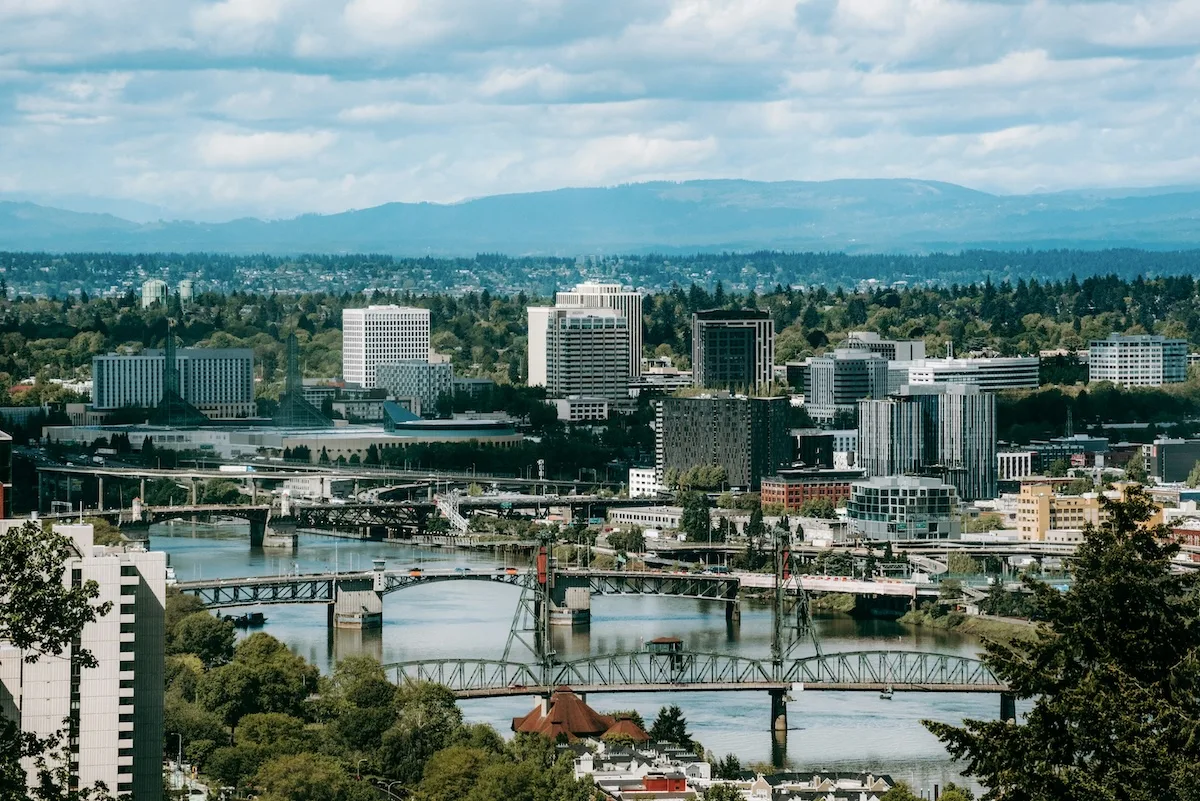
Portland’s $1,500 median rent represents a 1.45% year-over-year increase—modest compared to explosive growth in other markets. Nearby cities show different trajectories: Gresham dropped 4.76% year-over-year, Beaverton fell 6.77%, and Milwaukie declined 1.56%.
What’s driving these patterns? The region’s established remote work culture means fewer renters require daily commutes to Portland’s downtown core, making suburban locations more competitive. Tech industry presence in Beaverton creates employment centers outside Portland proper, reducing the need to live near the city center. The result: a metro area where renters can find affordability in multiple communities without sacrificing access to jobs, amenities, and urban infrastructure.
5 nearby, alternate cities to Portland
Gresham
Median Rent: $1,500 | Distance: 10.3 miles east | Population: 111,507
Portland’s eastern neighbor matches the city’s median rent while offering a decidedly different character. As Multnomah County’s second-largest city, Gresham stretches from suburban neighborhoods to semi-rural areas approaching Mount Hood’s foothills.
Studios rent for $1,149 (median), while two-bedrooms are $1,495 and generally provide more square footage than comparable Portland units. The city’s median household income of $76,952, based on U.S. Census Bureau data, suggests that many renters can comfortably afford rents of $1,924 using the 30% budgeting guideline (no more than 30% of a renter’s pre-tax income should be spent on rent).
The MAX Blue Line transforms Gresham from a distant suburb to an accessible alternative. Three stations connect residents to downtown Portland in 35-40 minutes.
Mount Hood Community College anchors the southern end, while downtown Gresham’s historic main street shows revitalization efforts. Outdoor enthusiasts appreciate proximity to the Columbia River Gorge and Mount Hood, and both under an hour’s drive.
Best for: Budget-conscious renters accepting suburban trade-offs; families wanting space; MAX commuters; outdoor recreation enthusiasts
Milwaukie
Median Rent: $1,575 | Distance: 5.7 miles southeast | Population: 21,620
Milwaukie delivers small-town charm with big-city transit connections. The MAX Orange Line—which opened in 2015—placed this historic Clackamas County city just 20 minutes from downtown Portland.
Downtown Milwaukie’s Main Street preserves early-20th-century architecture that houses independent shops, restaurants, and locally-owned cafes. The Milwaukie Farmers Market draws crowds May through October.
Studios rent for $1,455, one-bedrooms for $1,354, and two-bedrooms for $1,625, providing options across budgets. Households earning the city’s median income of $86,892 can afford a rent of $2,172, which means Milwaukie is affordable for many renters. The Trolley Trail offers car-free recreation along a former rail line.
Best for: Renters wanting small-town community with urban transit; MAX commuters; families seeking walkable downtown areas
Beaverton
Median Rent: $1,695 | Distance: 8.8 miles west | Population: 98,302
Oregon’s sixth-largest city combines suburban sprawl with urban amenities. Beaverton serves as the Portland metro’s western employment hub, hosting Nike’s global headquarters along with Columbia Sportswear, Tektronix, and numerous tech companies.MAX Blue and Red Lines provide dual transit access with multiple stations throughout the city.
The median rents for two-bedroom apartments ($1,695) and one-bedroom units ($1,445) are competitive with central Portland. The city’s median household income of $99,592 suggests that renters at this income level could comfortably afford to pay $2,490 in rent, so Beaverton is an affordable place to call home.
With 37% of its residents being foreign-born, Beaverton boasts multicultural dining scenes along Canyon Road. The Round entertainment district and extensive trail systems cater to varied interests and lifestyles. Cedar Hills Park and Tualatin Hills Nature Park provide scenic locations for outdoor recreation.
Best for: Tech workers; families prioritizing schools; renters seeking suburban amenities with transit access
Vancouver, Washington
Median Rent: $1,755 | Distance: 8.1 miles north | Population: 198,992
Crossing the Columbia River into Washington introduces tax considerations alongside rental costs. Vancouver—Washington’s fourth-largest city—offers different trade-offs from Oregon suburbs.
The primary draw: no state income tax. Washington residents working in Washington avoid income tax entirely, creating thousands of dollars in annual savings. However, Washington’s 6.5% sales tax adds costs Oregon residents avoid. Oregon workers living in Vancouver still pay Oregon income tax, which eliminates the tax advantage.
Two-bedroom units have a median rent of $1,682.50, while one-bedrooms rent for $1,507.50. Vancouver’s median household income of $82,928 supports these rents comfortably; the 30% budgeting guideline suggests households at this income level can afford approximately $2,073 monthly, making both unit types affordable for median earners.The slightly higher rental costs compared to Portland often mean larger floor plans in newer buildings compared to Portland’s older housing stock.
Downtown Vancouver’s waterfront renaissance brought restaurants, breweries, and the Vancouver Farmers Market. Fort Vancouver National Historic Site preserves the region’s history, including the Hudson’s Bay Company—the oldest corporation in North America, founded in 1670.
Best for: Tax-conscious Washington workers; families wanting newer suburban development; those seeking Portland access without Oregon income tax
Tigard
Median Rent: $1,749 | Distance: 9.7 miles southwest | Population: 57,301
Located southwest of Portland, Tigard blends residential neighborhoods with commercial corridors. Washington Square Mall—the region’s largest shopping center—anchors the northern end, while downtown Tigard features a walkable main street atmosphere.
The city lacks direct MAX service, so it relies on bus routes connecting to Beaverton’s light rail stations and downtown Portland. This creates longer commutes—typically 35-50 minutes to central Portland—but Tigard’s central location provides quick access to Beaverton, Lake Oswego, and Tualatin.
The median rent for two-bedroom apartments is $1,598, while one-bedrooms are $1,350. The city’s median household income of $108.823, based on U.S. Census Bureau data, reflects affluent demographics, with highly-rated Tigard-Tualatin School District drawing families.
Best for: Families prioritizing good schools; car commuters working in the southwest metro
How to choose the right city near Portland
Evaluate your commute priorities. MAX-served cities (Gresham, Milwaukie, Beaverton) support car-free living, while outer suburbs require vehicles. Calculate both time and cost—car ownership adds $400-$600 monthly beyond rent.
Consider lifestyle preferences. Small-town seekers thrive in Milwaukie. Families often prioritize Tigard or Beaverton’s schools. Urban-adjacent renters find Gresham or Beaverton offer the best of both worlds.
Examine total housing costs. Vancouver’s higher rent may be offset by income tax savings for Washington workers. Use Zumper’s rent calculator to compare all-in costs.
Factor job market considerations. Tech workers benefit from Beaverton’s concentration of employers. Remote workers can maximize savings in Gresham.
Think long-term. Cities with strong transit connections and diverse housing inventory offer more flexibility than car-dependent suburbs.
Frequently asked questions
What is the cheapest city near Portland?
Gresham matches Portland’s $1,500 median rent while offering more space. Milwaukie costs slightly more at $1,575 but delivers small-town character with excellent MAX access.
Which cities near Portland have the best public transit?
Gresham (MAX Blue Line), Milwaukie (MAX Orange Line), and Beaverton (MAX Blue/Red Lines) offer light rail connections to downtown Portland.
Should I live in Vancouver, WA or Portland, OR?
The decision depends on your employment and tax situation. Washington workers living in Vancouver avoid state income tax entirely. A Vancouver resident earning the city’s median household income of $78,156 would save approximately $6,800 annually compared to paying Oregon’s 8.75% marginal rate on that same income. Oregon workers living in Vancouver pay Oregon income tax regardless, making Portland often cheaper overall.
Are Portland suburbs more affordable than the city?
It depends on the neighborhood. Some of Portland’s most affordable options are actually in the urban core (downtown at $1,300), while others are in outer areas like East Portland. However, suburban-feeling neighborhoods generally offer larger units and more parking compared to dense central areas at similar price points.
How long is the commute from Gresham to downtown Portland?
The MAX Blue Line takes 35-40 minutes from Gresham’s City Hall station to Pioneer Square in downtown Portland. Driving ranges from 20-25 minutes off-peak to 40-50 minutes during rush hour.
Which cities near Portland are best for families?
Tigard and Beaverton top family rankings due to their highly-rated schools. Milwaukie balances good schools with more affordable pricing and transit access.
Can you live car-free in Portland suburbs?
Yes, but with limitations. Portland’s MAX light rail extends into outer neighborhoods like Parkrose and outer East Portland, enabling car-free living near stations. However, many of Portland’s suburban-feeling neighborhoods (like Wilkes, Centennial, and outer Southwest Portland) have lower walk and transit scores, making daily life challenging without a car.
What are the tax differences between Portland and Vancouver?
Oregon has no sales tax but charges state income tax (4.75%-9.9% depending on income), while Washington has no income tax but charges 6.5%+ sales tax. Portland workers living in Vancouver pay Oregon income tax, while Washington workers living in Vancouver avoid income tax entirely.
Data Source: Zumper’s listings, analyzed over the past 30 days
For more Portland rental insights, explore Zumper’s National Rent Report or our Cheapest Neighborhoods in Portland guide.
Related content